
Main Courses
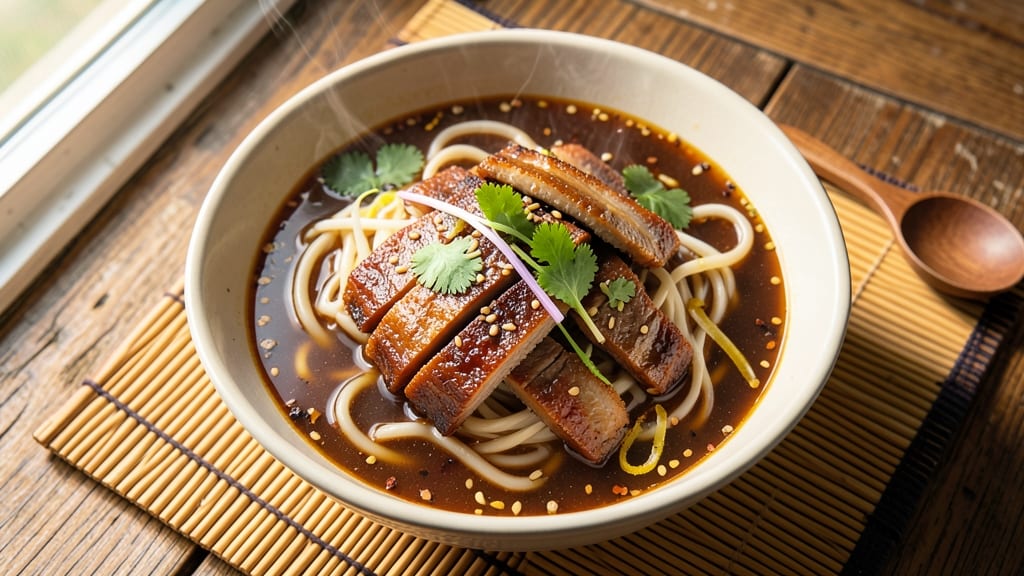
This Asian BBQ pork noodle soup delivers restaurant-quality smoky-sweet pork bites in a rich, aromatic broth that balances heat and depth. 🔥 I developed this recipe after years of perfecting the art of quick-braised pork—where tender meat meets caramelized edges, all simmered in a broth that's both comforting and complex.
The secret lies in charring the pork first, then braising it in a sweet-spicy sauce that develops layers of umami as it cooks.
The magic happens in the broth, where star anise, cinnamon, and ginger create warmth while soy sauce and fish sauce add depth. Thin rice noodles soak up the flavor perfectly, and a final touch of chili oil adds just the right kick.
What you end up with is a bowl that's hearty enough for a cold evening but quick enough for a weeknight—foolproof and deeply satisfying.
This recipe transforms simple ingredients into something extraordinary. The pork starts tender and finishes with a caramelized crust, while the broth develops a velvety texture that clings to every noodle.
Garnish with fresh herbs and lime for brightness, and you've got a dish that feels like a hug in a bowl—smoky, sweet, and perfectly balanced.
Perfect for feeding a crowd or meal prepping for the week, this soup scales beautifully without sacrificing flavor. Whether you're serving it to family or sharing with friends, it's the kind of dish that disappears faster than you can say "second bowl." Let's get cooking!
Ingredients for asian bbq pork noodle soup
Six ingredients transform into restaurant-quality smoky-sweet pork bites and rich broth.
| Ingredient | Amount | Notes |
|---|---|---|
| Pork Shoulder 🐷 | 2 lb | Cut into 1-inch cubes |
| Rice Noodles 🍜 | 12 oz | Thin, dried variety |
| Soy Sauce 🥫 | ½ cup | Light or all-purpose |
| Fish Sauce 🍶 | 2 tbsp | Red Boat brand preferred |
| Brown Sugar 🍬 | ¼ cup | Packed, light brown |
| Rice Vinegar 🍶 | ¼ cup | Seasoned or unseasoned |
| Chili Garlic Sauce 🌶️ | 2 tbsp | Or substitute chili oil |
| Star Anise 🌟 | 2 whole | Lightly crushed |
| Cinnamon Sticks 🌿 | 2 whole | 2-inch pieces |
| Ginger 🧄 | 2 tbsp | Fresh, grated |
| Garlic Cloves 🧄 | 6 cloves | Minced |
| Green Onions 🧅 | ¼ cup | Sliced, for garnish |
| Fresh Cilantro 🌿 | ¼ cup | Chopped, for garnish |
| Lime Wedges 🍋 | 2 whole | For serving |
| Vegetable Oil 🫒 | 2 tbsp | For charring pork |
The pork shoulder is your secret weapon here—ask the butcher for a well-marbled cut if possible. I grab mine from Whole Foods when I can, but any grocery store with a decent meat counter works. Cut it into even 1-inch cubes so they char and braise uniformly. For the rice noodles, Vietnamese or Thai brands at Asian markets are ideal—they're thin and soak up flavor like sponges. If you can't find them, egg noodles work in a pinch, but they'll be slightly chewier. The star anise and cinnamon sticks add that signature warmth—don't skip them, even if you're not familiar with Asian cooking.
No fish sauce? Soy sauce plus a dash of molasses gets you close, though it won't be identical. The chili garlic sauce can be swapped for sriracha plus minced garlic, but you'll lose some of that umami depth. For the ginger and garlic, fresh is non-negotiable—dried just won't cut it here. The brown sugar should be packed, not scooped, and light brown works better than dark for this recipe. If you're prepping ahead, make the sauce mixture (everything except pork and noodles) and store it in the fridge for up to 1 week—it'll actually taste better after flavors meld.
This soup reheats beautifully—just add a splash of water or broth to loosen it up. Keeps for 4-5 days in the fridge, freezes for 3 months if you portion it into containers. I always make a double batch because it disappears so fast. For serving, I like to keep the lime wedges and fresh herbs separate until right before eating—they wilt fast once mixed in. Garnish each bowl with a sprinkle of green onions and cilantro for that final pop of color and freshness.
Why You'll Love This Recipe
- One-Pot Wonder: I swear by this—just brown the pork shoulder, toss in the sauce (soy, fish, brown sugar), let it simmer while you boil noodles. No extra pans, no fuss. The pork practically falls apart on its own, so tender it melts in your mouth.
- Sweet-Savory Magic: That combo of soy and fish sauce with brown sugar? Chef’s kiss. It’s sticky, smoky, and just a little tangy—like a hug in a bowl. The pork gets this irresistible caramelized crust, but the broth stays rich and balanced. Honestly, I’ve tried shortcuts, but nothing beats this.
- Meal-Prep MVP: Make a double batch and store it for days. The flavors get even better as the pork absorbs the sauce. Toss cold noodles in later, and boom—quick lunch for the week. My kids grab it straight from the fridge, no complaints.
- Budget-Friendly Feast: Pork shoulder’s cheap, rice noodles last forever, and a little goes a long way. This feeds four for under $15, and the leftovers? Even better the next day. Between us, it’s my go-to when I’m broke but still want to eat well.
Step-by-step instructions for Asian BBQ pork noodle soup
Here's how to create smoky, caramelized pork bites and a deeply flavorful broth that'll make your noodle soup unforgettable.
🔥 Step 1: Char the Pork Shoulder for Deep Flavor
Heat a large skillet over medium-high heat and add the 2 tablespoons vegetable oil. Once shimmering, add the 2 lb pork shoulder cut into 1-inch cubes in a single layer. Let them sear undisturbed for 3-4 minutes until deep golden brown on all sides.
Here's the thing—this charring step builds the smoky-sweet foundation. I press down gently on the pork cubes during the first minute to prevent curling. Once browned, transfer the pork to a plate and set aside. You'll notice the pork releases easily when it's ready to flip—don't rush this step.
🍳 Step 2: Build the Aromatic Broth Base
In the same skillet (no need to wipe it clean—those browned bits are pure flavor), add the 2 whole cinnamon sticks and 2 whole star anise. Toast them for 30 seconds until fragrant. Add the 2 tablespoons grated ginger and 6 cloves minced garlic, cooking for another 30 seconds until the garlic turns golden.
Pour in 1 cup water (just enough to deglaze) and scrape up all those flavorful bits from the bottom. Add the 0.5 cup soy sauce, 2 tablespoons fish sauce, and 0.25 cup brown sugar. Bring to a simmer and let it reduce for 5 minutes until slightly thickened. This creates the perfect balance of salty, sweet, and umami.
🔥 Step 3: Slow-Cook the Pork Until Fork-Tender
Transfer the pork and all the aromatic broth to a large pot or Dutch oven. Add enough water to cover the pork by about 1 inch (approximately 3 cups). Bring to a boil, then reduce heat to low and cover. Simmer for 1.5 hours, turning the pork occasionally, until it's fork-tender and easily pulls apart.
I check for doneness by piercing the largest piece—if it slides off the fork with minimal resistance, it's ready. The broth should be rich and deeply infused with all those aromatic flavors. If it reduces too much, add a splash of water to maintain the right consistency.
🍳 Step 4: Finish with Tangy-Spicy Balance
Remove the pork from the broth and let it cool slightly. Once cool enough to handle, shred it using two forks. Return the shredded pork to the broth and add the 0.25 cup rice vinegar and 2 tablespoons chili garlic sauce. Simmer for another 5 minutes to let the flavors meld together.
Here's where the magic happens—the vinegar brightens the rich broth, while the chili garlic sauce adds just the right kick. Taste and adjust seasoning if needed. The broth should be perfectly balanced between sweet, salty, spicy, and tangy. If it's too acidic, add a pinch more brown sugar. If it needs more heat, add another teaspoon of chili garlic sauce.
🥘 Step 5: Assemble and Serve
Bring a large pot of water to a boil and cook the 12 oz rice noodles according to package instructions (usually 3-5 minutes) until al dente. Drain and rinse briefly under cold water to stop the cooking process.
Divide the noodles among bowls and ladle the hot pork broth over the top. Garnish each serving with 2 tablespoons sliced green onions and 2 tablespoons chopped fresh cilantro. Serve with the 2 lime wedges on the side for a bright finishing touch.
This is the moment that matters: the contrast of the warm, smoky broth against the cool noodles and the zesty lime. Each bite should deliver tender pork, aromatic broth, and perfectly al dente noodles—all coming together in one unforgettable spoonful.
Pro Tips For Making Asian Bbq Pork Noodle Soup
- SEAR THE PORK FIRST: Hit the pork shoulder with a screaming-hot pan—no oil needed, just the fat—and let it develop that deep caramelized crust before you even think about braising. I used to skip this, and the broth always tasted flat until I realized the Maillard reaction is what turns this from "meh" to "wow."
- SOAK NOODLES JUST BEFORE SERVING: Rice noodles turn to mush if you prep them too early. Instead, keep them dry in a bowl until you’re ready to serve, then soak for no more than 3-4 minutes in hot broth—just long enough to soften, not dissolve. Over-soaking is how you end up with a sad, gluey mess.
- BALANCE SWEET AND SALTY: Brown sugar and soy sauce are your flavor anchors, but fish sauce is the sneaky MVP. Use it sparingly at first—start with half the recipe’s amount, taste, then adjust. Too much fish sauce and your soup tastes like a science experiment gone wrong; too little, and it’s just sweet pork broth.
- SHRED COLD, NOT HOT: Let the pork shoulder cool for 10 minutes after cooking before shredding—hot meat pulls apart like wet cardboard. I learned this after wrestling with a pile of stringy, sad pork. A fork works, but my hands (and my patience) thank me for using two forks or a sturdy pair of tongs instead.
Essential equipment for this dish
Skillet Essentials
Start with a 12-inch cast-iron skillet—it's my go-to for charring pork because it retains heat beautifully and builds deep flavor from those browned bits. I swear by a Lodge Pre-Seasoned Cast Iron Skillet—it's affordable, durable, and develops a natural non-stick surface over time.
For a lighter option, a stainless steel wok works too, especially if you're cooking for a crowd. 🔥
Don't skip the tongs—I use OXO Good Grips because they're heat-resistant and give me a secure grip on those pork cubes. A sharp chef's knife (I prefer Wüsthof) is essential for cutting pork into even 1-inch cubes, which ensures uniform charring and cooking.
Keep a wooden spoon nearby for stirring the broth without scratching your skillet.
Broth-Pot Upgrade
For the slow-cooking phase, a Dutch oven is my holy grail—it's heavy enough to distribute heat evenly and holds enough liquid to cover the pork. My Le Creuset Signature Round Dutch Oven (5.5-quart) is my workhorse, but a stainless steel stockpot works in a pinch.
If you're short on space, a slow cooker (like my Hamilton Beach 6-quart) can handle the 1.5-hour simmer beautifully—just add the pork and broth directly to it.
For measuring liquids, a clear glass measuring cup (like Pyrex) lets me monitor broth levels while cooking. A fine-mesh strainer comes in handy if you want to strain the broth for a clearer presentation—though I usually leave it whole for maximum flavor.
And trust me, a digital meat thermometer (I use ThermoWorks Thermapen) is non-negotiable for checking pork doneness at 203°F internal temperature.
Noodle Prep Tools
Rice noodles cook faster than you think, so have a large pot with a tight-fitting lid ready—my All-Clad Stainless Steel Pot handles the job perfectly. A slotted spoon (like OXO's Good Grips) makes draining noodles a breeze without losing too much water.
For rinsing, a fine-mesh colander with a sprayer attachment keeps things tidy.
Garnishing is where small tools make a big difference. I use small sharp scissors to slice green onions quickly, and a microplane for fresh ginger if I'm feeling fancy. A lime zester adds decorative lime curls to bowls, but even a peeler works in a pinch.
For serving, I love wide, shallow bowls (like Corelle Stoneware) that let everyone see the vibrant layers of flavor in their soup.
Optional Pro Upgrades
If you're serious about elevating this dish, consider a smoking gun (like Masterbuilt 200717) for adding subtle smoke to the broth—just a few puffs of hickory or applewood at the end takes it to the next level.
For extra crispiness, a mandoline (set to 2mm thickness) slices pork thinly for garnish. And if you're making this often, a food mill (like OXO Good Grips) makes shredding pork effortless.
My motorcycle rides often inspire me to forage wild herbs like lemongrass or Thai basil—toss a few sprigs into the broth for an unexpected twist. For heat control, I keep chili crisp (from Maesri Thai Kitchen) on hand to adjust spice levels at the table.
These aren't essential, but they're the little luxuries that make this soup feel truly special. ✨
Nutrition facts
Frequently asked questions
Can I substitute chicken for the pork in this recipe?
You can try, but the flavor and texture will be different. Chicken breast cooks faster and stays less tender when braised, while pork shoulder stays juicy and develops that perfect caramelized crust. For best results, use chicken thighs instead—they're more forgiving and stay moist during the long simmer. If you do substitute, reduce the cooking time to 45-60 minutes and check for doneness early.
How do I adjust the spice level for picky eaters?
Start by reducing the chili garlic sauce to 1 tablespoon instead of 2. For extra mildness, replace it with 1 teaspoon of sriracha or omit it entirely. If you want heat but want to control it, serve the chili oil on the side so everyone can add their own. The broth's natural depth comes from the fish sauce and soy sauce, so you won't sacrifice flavor—just the kick.
Can I make this soup in an Instant Pot?
Char the pork first in a skillet, then transfer it to your Instant Pot with all the broth ingredients. Cook on high pressure for 25 minutes, then quick-release. Shred the pork, return it to the pot, and finish with the vinegar and chili sauce on sauté mode for 5 minutes. The noodles should be cooked separately and added just before serving. This cuts the cooking time dramatically while keeping all the flavor.
Why does my broth taste too sweet or salty?
This usually happens when the flavors aren't balanced properly. If it's too sweet, add a splash of rice vinegar or lime juice to brighten it up. For saltiness, dilute with a little hot water or add a pinch of white pepper to enhance other flavors. Taste as you go—adjust one ingredient at a time. The broth should be complex, not one-dimensional, with all flavors working together.
How can I make this recipe vegetarian?
Swap the pork for extra-firm tofu or shiitake mushrooms (for umami depth). Press and cube the tofu, then pan-fry until crispy before adding to the broth. Use vegetable broth instead of water, and add 1 tablespoon of miso paste to boost savory flavor. The noodles and broth will still shine—it just becomes a vegetarian noodle soup with all the same comforting qualities.